

How Many Amps Does Tv Draw
Ability consumption specifications for TVs tin can be a bit of a pain to come by these days. Lucky for you I dug through the manuals of half-dozen of the most popular TV brands and summarized their power usage details below.
How many amps does a television use?
The average American Tv is fifty inches and uses 0.95 amps at 120 volts. That works out to an average Goggle box power consumption of 113 watts. In a given year, the average Television set volition use 142 kWh and cost a little over 17 dollars (assuming 5 hours of use per day).
| Brand (fifty'') | Amps | Watts | KwH per year | Price per year |
|---|---|---|---|---|
| Toshiba (4K UHD) | 0.66 A | 79 Westward | 150 kWh | $xviii |
| Samsung (7 series) | 1.thirteen A | 135 West | 120 kWh | $14 |
| Sony (X80J series) | i.22 A | 146 W | 179 kWh | $22 |
| Vizio (M series) | one.09 A | 131 W | 154 kWh | $19 |
| TCL (iv serial) | 0.66 A | 79 W | 100 kWh | $12 |
| Hisense (A6G serial) | 0.92 A | 110 W | 148 kWh | $18 |
| Average | 0.95 A | 113 W | 142 kWh | $17 |
Average American TV size
Amazingly, the boilerplate American TV size has more than doubled from 1998 to today, growing from 23 to fifty inches.
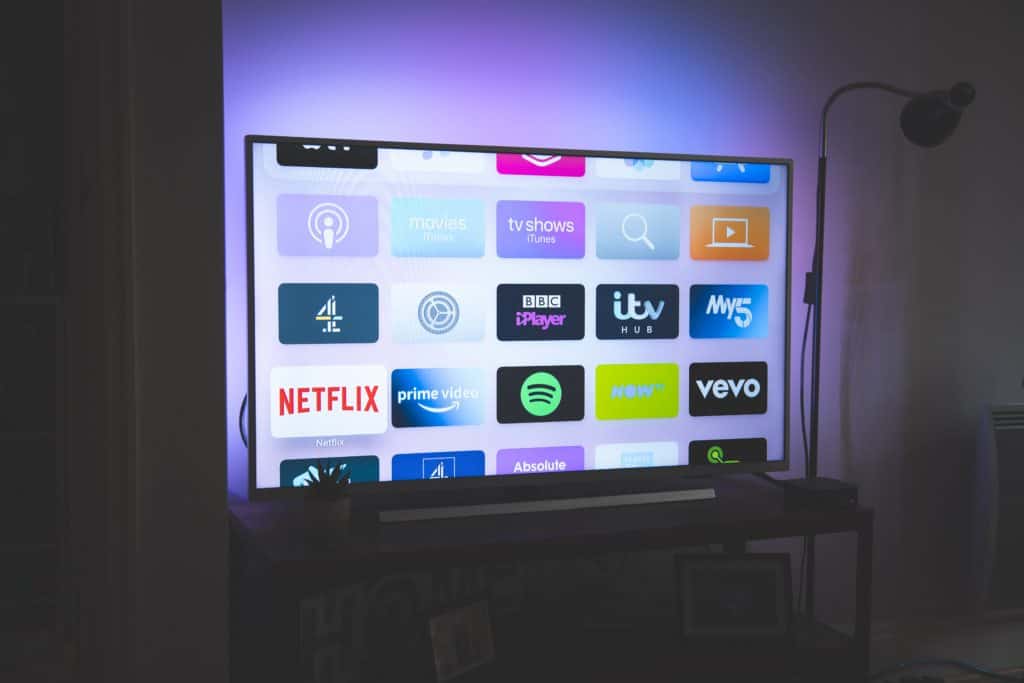
The average TV size is extremely important to know when trying to determine how many amps a TV uses. Smaller TVs volition use far less amperage, and larger TVs will use more.
This is because larger TVs have higher power consumption requirements. For instance a typical 85" inch TV uses over 400 watts, whereas a 43" TV uses a few as 100 watts.
So larger TVs use more watts, only how do watts impact amperage, yous enquire?
Great question.
Amps, volts and watts
I won't get into all the details virtually what exactly amps, volts and watts are (at that place are plenty of great resources for that).
But for our purposes, what'south important to know is that amps = watts/volts.
In the typical American home, the supply voltage at the power outlet is a consistent 120 volts.
So, knowing that the volt portion of our equation will remain abiding at 120, that means watts are what volition ultimately make up one's mind how many amps the Idiot box uses.
The more watts, the greater the amperage.
Larger, and less energy efficient TVs, use more watts, and in turn, more than amperage.
Accept for case the Sony fifty" X80J series television. It uses 146 watts. If we split up 146W/120V we get 1.22 amps. That's almost double the TCL fifty" iv series which only uses 79 watts!
And, as yous can imagine, yous most certainly pay for this departure over the course of a yr. That Sony 50" costs nearly twice as much as the TCL to power.
That said, TV costs in general are extremely low, regardless of which Telly you take and at that place are many different factors that atomic number 82 to overall TV power costs.
What factors touch on Telly power costs?
If y'all've gone shopping for an appliance in the past decade y'all've probably seen a yellow Energy guide sticker.
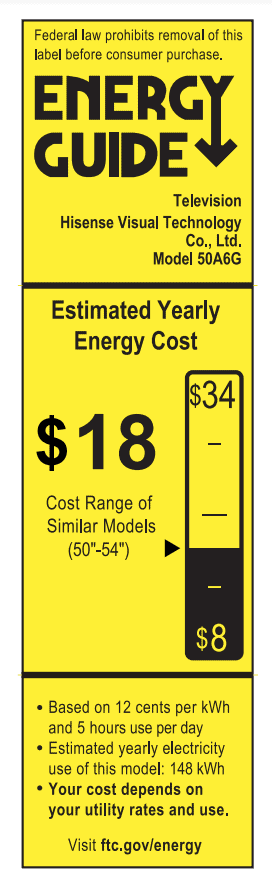
This sticker is required by law and it details just how much energy that exact appliance uses and how much you can expect to pay to power it for a total year.
Energy guide labels on TVs, like all appliances, are based solely on estimates. At that place are a neat number of factors that can increase, or decrease your TVs' ability costs.
For instance:
- How many hours of Television you watch per day. All TV energy costs are estimated based on the assumption of v hours of utilize per solar day. If you use your Goggle box more or less than this, your costs will differ. That said, fifty-fifty if you utilise your Boob tube for a whopping ten hours a day, your annual costs will still exist <100 dollars.
- Utility/power rates. The amount you pay for power depends largely on where you live and if you have solar or other renewable energy sources. Energy guide calculations assume eleven cents per kWh. Your bodily costs may be lower or higher. Mine, for example, are higher.
- TV settings: Energy guide calculates costs based on the TVs' default movie settings. These settings well-nigh always utilise less energy than every twenty-four hour period use.
- The number one TV setting that impacts power uses is brightness/contrast. The brighter your Television, the more than ability it will utilise and the college the annual cost.
- Power salvage mode is offered by some TVs and is worth turning on if your TV has information technology. This more or less automatically adjusts the TVs brightness settings so they are optimal for viewing and cost.
- Another option is to lower the volume or mute the TV during commercials. This way your TV isn't using power for sound when y'all're non really paying attending anyway. You might just discover you really prefer the peace and tranquility!
- Finally, consider using the programmable timer (sleep timer). This is perfect for those of us that tend to fall comatose in the middle of a movie or bear witness and end up leaving the Tv set on all nighttime. With the sleep timer on your TV information technology will shut off automatically.
Decision
The boilerplate Television set size in America today is a whopping fifty inches, up from 23 inches back in 1998.
So how many amps does a goggle box employ if the average TV is 50"?
The average 50" TV uses nigh 0.95 amps at 120 volts. That works out to an average TV ability consumption of 113 watts.
Over the course of a year the typical 50" Telly costs just 17 dollars to power (142 kWh per year at 11 cents per kWh).
Larger TVs use more watts and in turn, more amperage. That's because amps = watts/volts, and in America the volts always equal 120.
In that location are a handful of factors that influence TV ability costs such as the number of hours you sentinel per day, your local power/utility rates, and the settings on your Tv.
That'due south why each individual's annual Television receiver costs will vary, but even if your costs are double the American average, you'll simply be paying about 34 dollars a yr! Corking.

Source: https://goodhomeautomation.com/how-many-amps-does-a-television-use/
Posted by: edwardswiging.blogspot.com
0 Response to "How Many Amps Does Tv Draw"
Post a Comment