

how to draw like a product designer
UX professionals tin can choose from a myriad of methods when information technology comes to the production design process and evolution. This article will give an overview of the production design steps and UX frameworks we consider to be essential. We'll also provide a toolbox you lot tin can pick ideas from when designing a Minimum Feasible Product, the first version of a product with merely enough features to create value and provide feedback for future development.
The platonic product design process can vary depending on different factors. These are such as the UX project scope, the size of a company, budget, or deadlines — merely to mention a few. In a good pattern procedure, the business requirements meet user needs, which are satisfied inside the viable technical possibilities. Even UX studio'southward production designers don't have simply one crystal clear guide for pattern processes.
Our UX designers frequently assemble and share the feel and cognition caused from different UX projects we practice for our clients. This helps the states amend our blueprint processes finer, to meet the requirements and demands of the market. This is not only useful for a UX professional's continuous development but also helps in designing a production that serves a client's business needs the most.
During the product design procedure, nosotros encourage an agile style of piece of work, working in design sprints, but nosotros are flexible if needed. If you need help with product design, achieve out to the states, and let'south discuss how we can aid you.
Steps of a user-centered production blueprint process
We utilize the Double Diamond product design process with iv phases: Detect, Ascertain, Develop, and Deliver. The production design process starts with the production discovery phase. Nosotros do not define annihilation yet. First, our UX designers and researchers look into the problem space and pinpoint the problems that should be solved. Furthermore, they determine a management for the next product design process steps based on their insights.
Secondly, the next role of the diamond — Develop and Deliver — is mainly based on the production discovery findings. However, this is not a linear process. The Discover and Develop tracks tin run simultaneously and support and feed into ane another at regular intervals.
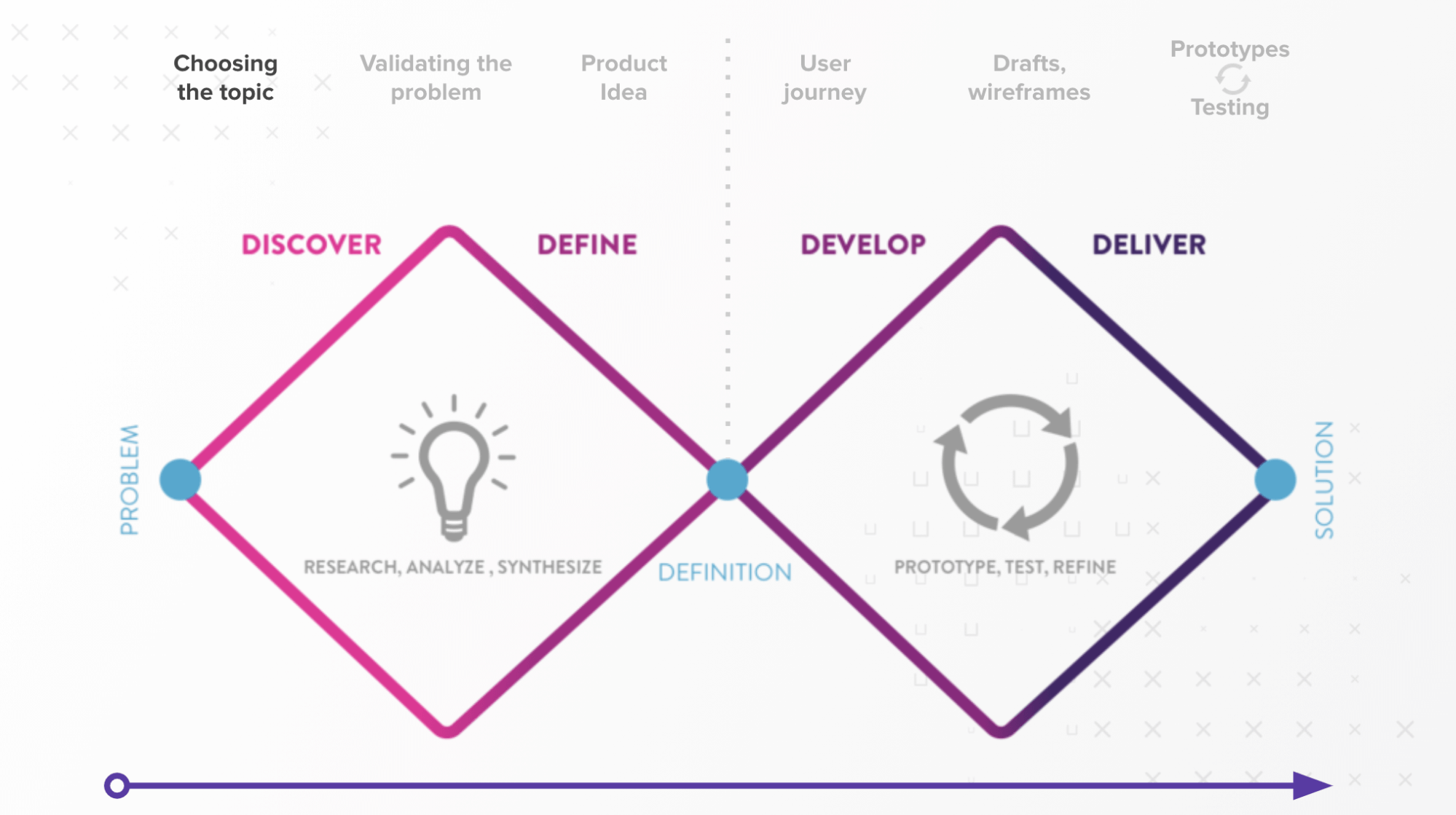
The Double Diamond product blueprint process model
Based on the Double Diamond model, nosotros follow four steps during the product pattern process in a flexible, not-linear way. In the next department, we will expect into these steps in more than detail.
- 1. Production discovery
- two. Narrow downward – Define
- 4. Brainstorming solutions, defining and prioritizing features
- 5. Narrow downwardly – Deliver
Step 1: Product discovery
What problem do we want to solve and for whom
Product discovery is the starting time phase of every human-centered production design process. Its purpose is to base of operations the digital product idea on actual demand. While UX research is an essential role of this footstep, let's not forget that conveying out enquiry is not only important at the beginning of the product designing procedure only at any given product design phase.
Whenever there are also many open up questions and uncertainties, dissimilar UX inquiry methods tin provide solutions and validate ideas, which, in the long run, will help to avoid called-for coin and waste time. UX professionals reach out to both the stakeholders and the users to explore the trouble and opportunity infinite and notice the central hurting points that need solutions.
In this section, nosotros'll look into two product discovery activities our UX professionals frequently employ at UX studio:
- Kick-off workshop
- Exploratory enquiry and user research
Market inquiry findings are also of import. At UX studio, we concentrate on UX research but if you're curious about the differences between user and market inquiry, check out our article on this topic.
Kick-off workshops
Come across your client, understand the current country of the projection and the boosted knowledge needed. Boot-off workshops are not bad for acquiring domain knowledge in a topic and get acquainted with the stakeholders.
To create the first draft of our roadmap, we start every product pattern process with a kick-off workshop. This commonly takes virtually ane to two days. At this time, nosotros get to know the visitor, its processes, and roles and gather all information we tin nearly the project.
If our client already has some quantitative and qualitative information — virtually the market, client partitioning, competitors, target group, or heir-apparent personas — nosotros get through them. At this point, we make a mutual understanding of the objectives and facts and build assumptions and hypotheses.
The best fashion is to involve the widest variety of expertise we can and get every bit many insights from different company stakeholders as possible. It's important to understand previous solutions and key business organisation objectives such as KPIs or success criteria.
Kicking-off workshop techniques nosotros frequently employ:
At this bespeak, most of the workshop deliverables are assumptive. That's fine considering we're going to research what nosotros need to validate or change.
- Assumption matrix
We collect the stakeholders' insights on different topics, find the most important ones, and high-risk "leap of faith assumptions" and then we can validate these with research and find out if they're existent. - Persona workshop
Assumptive personas are our best guesses on who will use the product and why. It helps us to recruit for interviews and for the client to sympathize with their future users. - Customer journey workshop
These workshops help us get a view of how people navigate through the production or service. It is likewise an excellent opportunity for cognition sharing with our clients. - Value Proposition workshop
We map out the perception of the value of the production identified by users. We too validate assumptions and thus Value Proposition for each customer segment. This provides vision and guides the design. - Brand Vision, Mission, and Values
The all-time style to reveal the vision is past asking the brand's key personnel why information technology was created. For every answer they provide, we inquire them to explain the why. After a few rounds of back-and-forths, we get to the heart of the matter.
At the stop of the boot-off workshops, we should accept a clear overview of what nosotros don't know enough about but should do, then we tin create a research plan to kickstart our discovery.
Research
There are diverse research methods out at that place. The simplest method that requires the least experience and professional knowledge is desk research. Information technology is available for anyone with a computer with cyberspace access, an business relationship for social platforms, and some time to dig up the pain points of online communities and discover opinions and reviews shared in social platforms, forums, mailing lists, or blog comments. Diary report can also be useful in some cases. If you want to gather data on a larger scale, yous tin can use online surveys — preferably with a mixture of open-ended and closed questions — that can be used with qualitative insights from other methods.
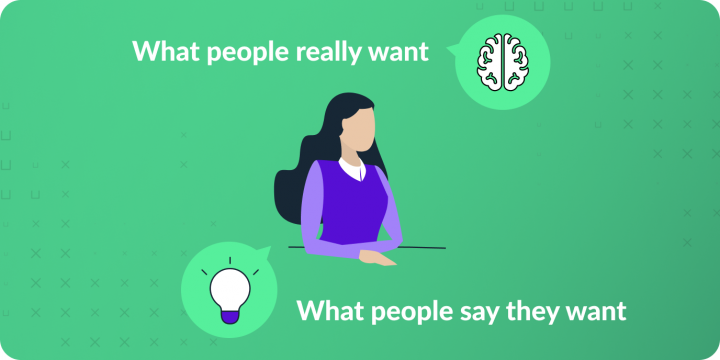
In the discovery phase of a product blueprint process, we don't aim to evaluate possible solutions yet as that comes afterward with usability tests. Still, nosotros may already have assumptions to validate, and nosotros certainly need to have a well-divers topic and a target group that is interested in our topic. At the same time, it's crucial to keep an open mind to be able to notice entirely new aspects and issues of our audience.
Research methods we frequently apply:
- Semi-structured user interview
We use this method well-nigh frequently in the discovery phase of the production design process. It's relatively easy to organize and provides keen insights. Starting with ten to fifteen interviews provides enough understanding to move frontward. We try to recruit interviewees from each segment or target grouping we defined earlier. Furthermore, we involve the stakeholders in writing the interview script. Our researchers evaluate the previous results earlier each interview and iterate the questions to go the near useful answers from the remaining interviews. If necessary and our collaboration has the resource, nosotros do follow-upwards interviews to dig deeper into sub-topics.
- Competitive research
It is very likely that by this bespeak of the production design process, the product team already gathered the chief direct and indirect competitors from stakeholder meetings and user interviews. More knowledge about successful competitors tin can aid us with feature ideas or design inspirations and tin can aid us to position our client's product. Even if there is no in-depth competitive inquiry, we should at least maintain a competitor list in a collaborative spreadsheet or whatsoever cloud-based tool.
- Field enquiry
Field inquiry is an extremely reliable method every bit it is based on observing user behavior in their environment. Simply for this very reason, it's harder to organize and conduct without influencing the users' behavior and interfering with the natural style of executing their daily tasks.
Step 2: Narrow down – Define
This step of the production design procedure involves making sense of the data, synthesizing them, choosing 1 primary goal to solve, and figuring out the "How" and the "What."
By the terminate of the discovery stage, we are probable to have plenty insight to synthesize our findings, refine our previous assumptive deliverables or create new ones by user analysis, define the core trouble we want to solve, build themes, and deduce potential fields of action.
From the many possible synthesizing activities, we'll look into three methods — the ones we use the most at UX studio — in more detail:
- User personas
- Jobs-to-be-done
- How might we
These exercises can be used at diverse points of the production design procedure. At the kickoff, in an assumptive way, it can aid with synthesizing the research data and ascertain the project scope. However, it can also exist applied when ideating solutions. The when and how depends on the team, project, and bachelor insights.
User Personas
User personas are fictional yet realistic representatives or archetypes of our key user groups with certain goals and characteristics. We use personas to assist us understand and map out the chief segments of our users, with their dissimilar goals and motivations. Nosotros can likewise apply them to aid us sympathize with them in society to design a product that is the most suitable for the users.
At UX Studio, we create assumptive, theoretical persona mock-ups at kick-off meetings. If provided, we can use already existing inquiry data, such as survey results, built buyer personas, or other related market place inquiry findings, to start off with, but at this betoken in the product pattern process, our personas should be validated and based on existent user research data.
There are many contradictory opinions out there about whether it's proficient to requite names and faces to personas, if demographic data is relevant, if it needs to exist printed, if information technology should include an empathy map, and and so on.
How we create personas:
- We would rarely need to go above 3 to five personas. At the aforementioned time, the number depends on the projection scope and product type. The broader the target audience, the more personas you lot may need. Nevertheless, it'due south better to iterate on categorization to avoid having too many personas as information technology can jeopardize the blueprint process in the long term. It's pretty hard to design for too many people with different sets of characteristics.
- Westward due east don't spend hours and days creating fashionable persona posters to hang on the wall. This is considering we know they'll change and go refined, and then in that location is no point in wasting hours on this during the process .
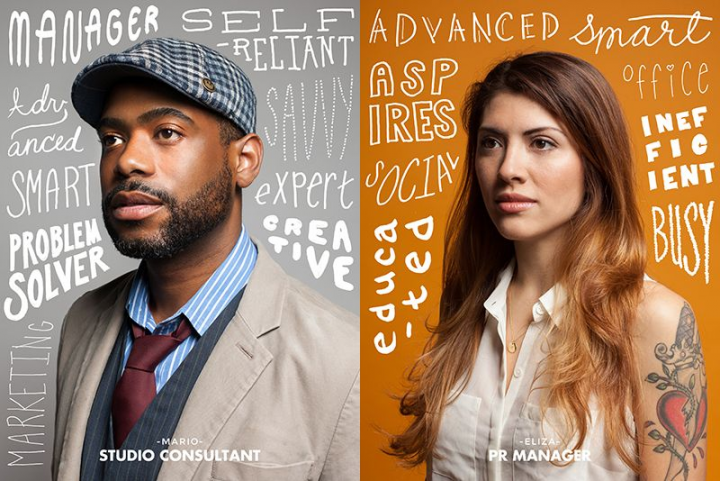
Our persona sheets include:
- goals and motivations,
- frustrations,
- beliefs patterns,
- groundwork,
- and context-specific details (details relevant based on the project, e.g., which mobile platform they use).
Nosotros also add a profile paradigm, proper name, some personal details, and demographic data to help with building more empathy and make them easier to remember.
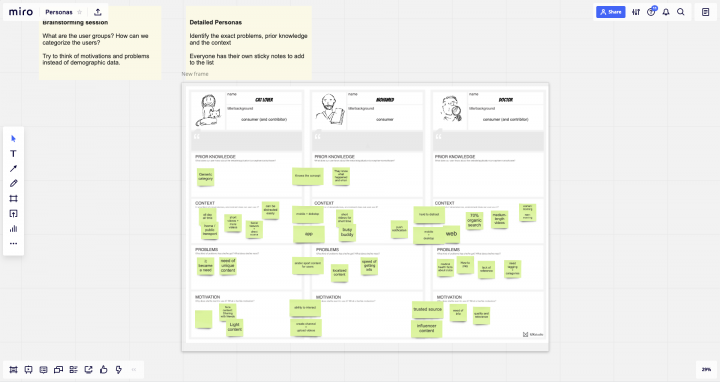
At that place are plenty of methods for synthesizing data, but we just dig deeper into the ones nosotros use most frequently. You can notice our downloadable persona template here .
Jobs to exist done (JTBD)
JTBD is another framework nosotros can use to find out more about the users' needs and preferences. Information technology is compatible with user personas, and then we oft use them together.
The personas focus more on the users' behavior and attitude, thus help with empathizing and segmenting the different types of users. In contrast, JTBD places a more significant emphasis on features. It aims to discover the reason why people choose a product in order to solve a specific problem and fulfill a demand.
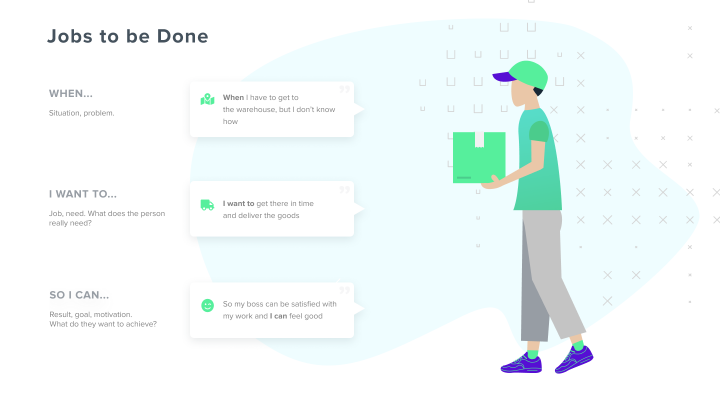
JTBD in real life
A famous JTBD example is continued to the milkshakes in McDonald's. When the company wanted to increase the profit on their milkshakes, they outset started interviews with representatives of persona groups, the client types they knew to be the principal milk shake consumers.
The researchers tested the temperature, the viscosity, and the sweetness of the milkshakes with this group, merely they couldn't find out how to improve the product. So they tried another approach.
They started observing and interviewing consumers on-site in McDonald's restaurants. It turned out that people bought milkshakes mainly to go along them total till tiffin and entertain them for the whole journey of driving to work. As a result, McDonald'south fabricated the milkshake thicker in order to last longer while commuting.
They also moved the milkshake car from behind the counter to the front. This manner the customers could easily and rapidly buy a milk shake with a prepaid card when rushing to work and avoid queues. Solving the real job to be done resulted in a sevenfold increment in the sales of the milk shake.
"How Might We"
The HMW exercise is a groovy way to narrow down problems and detect possible opportunity areas.
We are non looking for exact solutions here all the same, but rather brainstorm, explore questionable areas of core challenges while keeping an open mind for innovative thinking. For this to piece of work, first, we need a clear vision or goal. This tin can be a Point of View statement based on a deeper user needs discovery. The POV should exist human-centered, neither also narrow, to sustain creative freedom when brainstorming, nor too broad, so it remains manageable.
For defining the POV argument, personas and JTBDs we made earlier in the blueprint process come in handy. By synthesizing the essential needs to fulfill, nosotros make a template to create a statement.
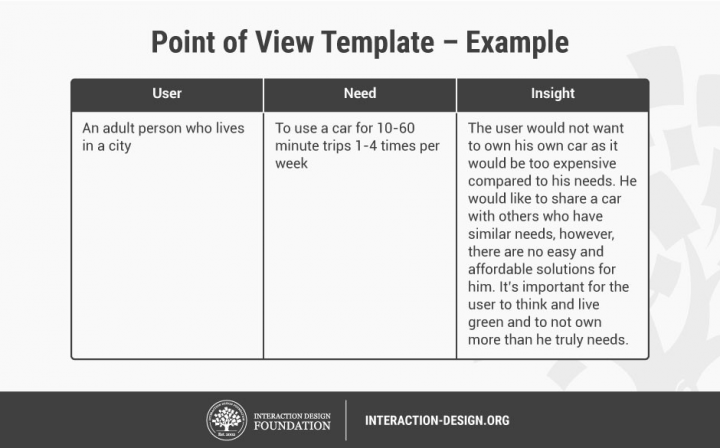
In short: [User . . . (descriptive)] needs [Need . . . (verb)] considering [Insight . . . (compelling)]
Once nosotros have the POV statement, we are ready to form short questions that tin launch brainstorming on actionable ideas. For instance:
- How might we…?
- What'due south stopping us from…?
- In what means could we…?
- What would happen if…?
So nosotros may inquire follow-up questions on the previous questions to examine the angles a scrap deeper. By completing HMW sessions, we can get one pace closer to forming ideas virtually exact solutions and executing the best ones.
Past this point , we should have a condensed brief of research findings, a strategy, and a articulate idea nigh what trouble we desire to solve.
At this stage of the production design process, we're far from creating high-fidelity prototypes and design systems. Yet, information technology's of import to set a couple of wide, basic directions to accept a full general idea of where we're heading. This tin can too help with nurturing the creative imagination equally we progress in the design process . Creating mood boards or a brand wheel tin exist a useful way to summarize our findings and have a point of reference during the next steps.
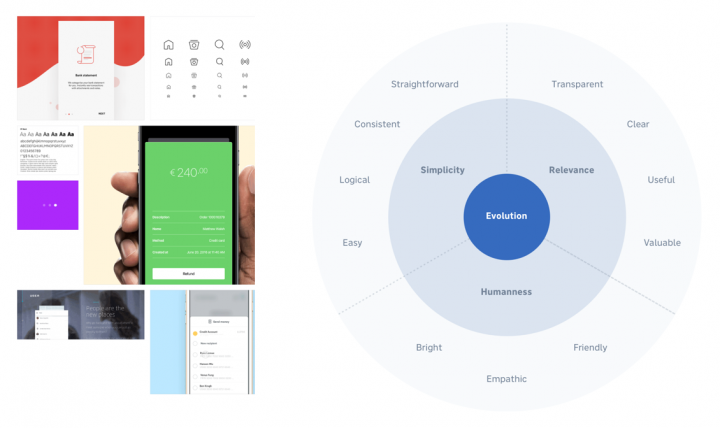
Depending on how many designers are working on a project, we can share the workload and either work on the aforementioned blueprint or carve up upwardly the tasks and progress simultaneously. For example, one person does the prototyping while the other is building the pattern system and hullo-fi part.
Step iii: Begin solutions, define and prioritize features
The techniques nosotros mention hither can exist done or can at least be started way before this step. Remember, this is not a linear process, and it is possible to use these techniques in a unlike society or at dissimilar times of the projection timeline.
The ideation phase begins when we have a good understanding of the project goals, and we narrowed down what we desire to solve first.
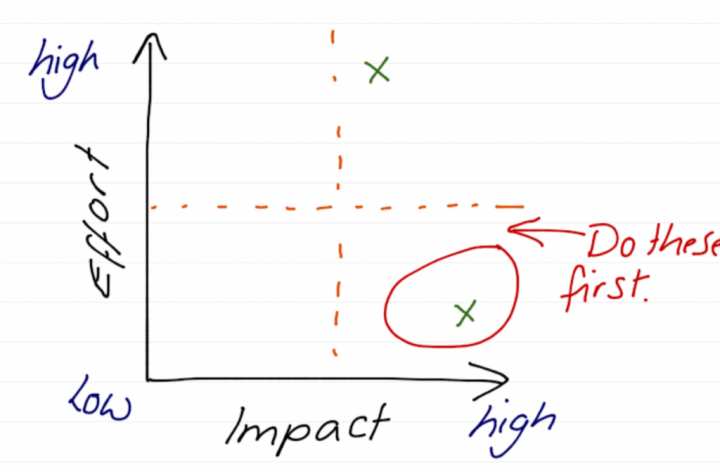
If there are still open questions near what features we should beginning with, the Kano model and the Touch-Effort Matrix can be helpful aids.
User journeys and customer journeys
User journeys and customer journeys are tools for mapping out the flows users go through when using a service or an application with one specific chore to carry out.
Customer journeys and experience maps run into the online and offline aspects of the users' period, providing a more holistic view of the procedure. As the output, the customer journey diagram lays out a large table. The columns of the table represent different phases or steps a customer goes through. These tin can exist unique in every project, but about client journeys contain three phases: before, during, and after the usage of our product.
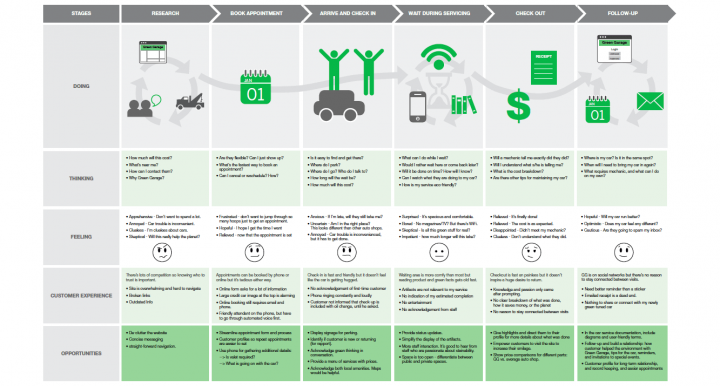
Opposed to customer journeys, user journeys analyze a smaller part of the journey. For instance, they are focusing just on what happens in the awarding. Such every bit, during a sign-up procedure. At UX studio, we mainly use user journeys, but for longer projects with a bigger scope, especially if there is already existing user data nearly the customers and in that location is a journey that goes beyond application usage (east.one thousand., arriving at the airport and using a ticket machine software), the customer journey is the preferred tool.
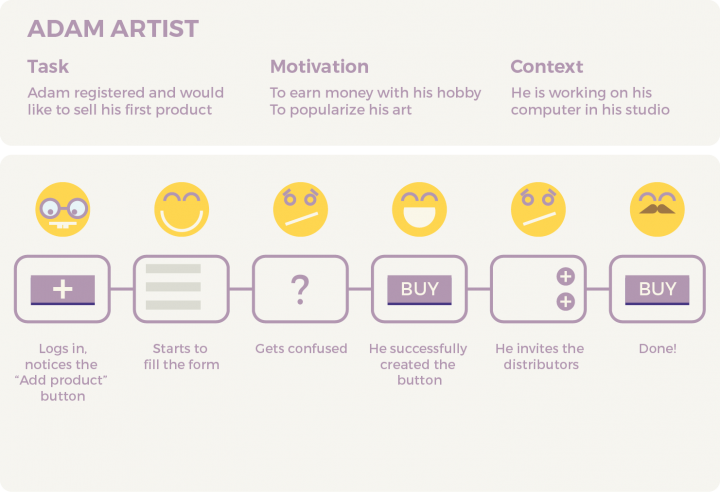
How we make user journeys:
- To first off, we determine the two or 3 most important goals the production should reach. Every journey must accept a job, motivation, and context.
- Information technology'south also good to include a simplified empathy map nested within the journey map, indicating what emotional reaction the user has at each step. These are good indicators for us on which points nosotros should handle with actress care or improve. These emotions can be assumptive but can as well exist based on solid data we gathered from our production discovery and enquiry earlier.
- Creating user journeys is withal part of the experimental phase. We don't finish with 1 thought but try out dissimilar paths, reorganize the steps, complete the ideas, and explore.
- We desire to find many dissimilar versions for each journeying, as sometimes at that place are great commencement ideas, merely oftentimes these are non the all-time solutions. For this reason, we create at least iii unlike journeys for each goal. Then, in one case we come with several solutions, decide on the winner.
User stories
User story creation is a good style to ascertain features with stakeholders. What nosotros want to accomplish in the product, why, and as what kind of user. It helps usa stay focused on what features are necessary to focus on during the upcoming product design phases and reminds us what could atomic number 82 to a "feature creep."
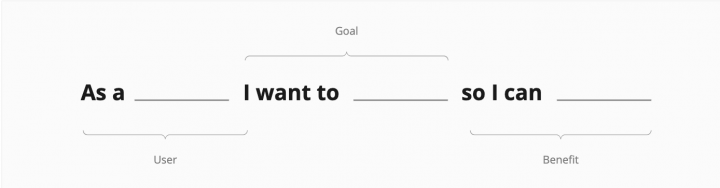
Loftier-level case:
As a sales agent , I desire to turn more than leads into customers so I can increase my income.
And a more detailed version of the case above:
As a sales agent , I want to proceed rail of unprocessed hot leads then I can make certain I don't miss out on an 'easy' deal .
We can create user stories in several ways and styles. If nosotros work on it with developers, it may become more than technical and scrum-oriented.
Building the IA, sketching, and wireframing
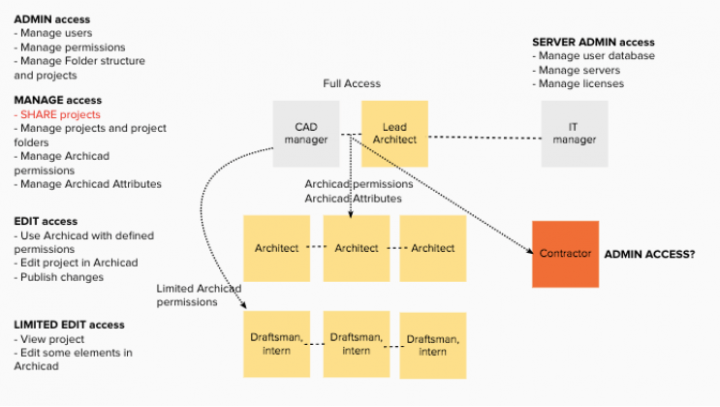
Building an Data Architecture is basically creating the blueprint of our pattern structure, the foundation of our get-go wireframes. IA is formed by creating a hierarchy and categorization of the information we gathered during the product designing process that results in a coherent, meaningful, navigable system.
How we sort out the features, functions, and available data in our product volition significantly impact the user experience. Our all-time intentions with features can vanish if users don't find them.
Carte sorting is a great technique to validate our information architecture. We tin practise information technology on newspaper, but in that location are some online tools that tin be very helpful too.
Sketching
We tin start sketching early in the product blueprint procedure when the first problems gain their shapes. Sketching is corking not merely considering it tin can serve equally a base when building something, but it too helps sympathize a trouble. Information technology also makes sharing ideas within the squad easier.
How we do sketching
Sketching on paper, where complex interfaces and functions of the software don't limit or distract us, is an constructive and rapid fashion to explore ideas and spot any design problems early on.
Nosotros don't need to exist practiced sketch artists or graphic designers who can draw and pigment photograph-realistically. The point hither is non to create refined artifacts but to focus on ideas, flows, and possible layouts and use simple placeholder boxes for images and text. Information technology'due south about exploring execution ideas, then we don't need to worry about the re-create either at this phase.
It's very useful to showcase the first sketches and wireframes with developers and other team members early in the procedure. When we practise so, they can share information on what is technically feasible and what is not, saving the states from unnecessary rework.

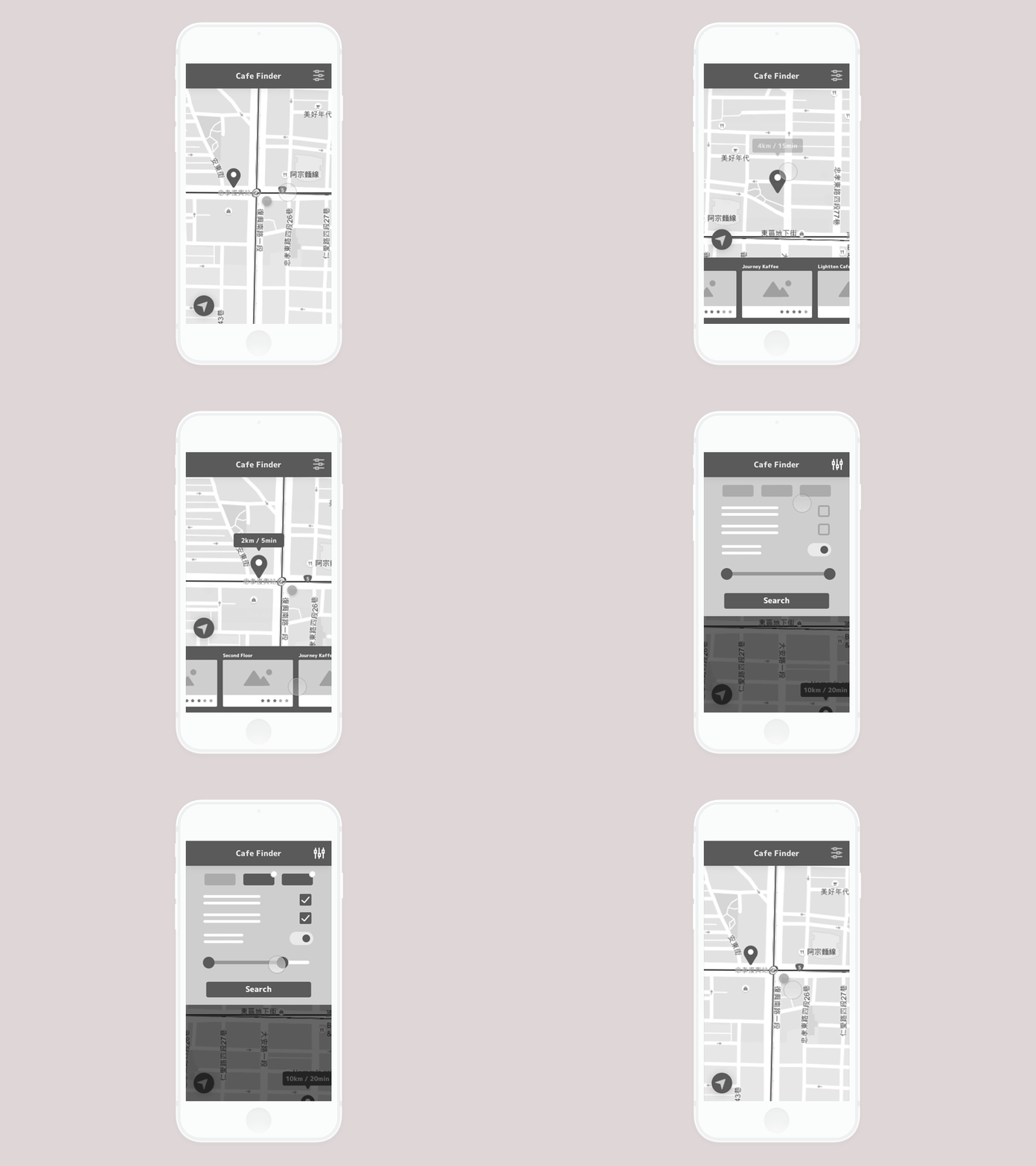
The output of sketching is a wireframe, which is basically the skeleton of our upcoming prototypes — a barebone, static construction that will soon evolve into a refined design. A blank paper and a pencil are all we need, merely using mock-ups for guidance tin be helpful. Wireframes can also be fabricated on digital platforms, using tools such as Axure, Adobe XD, Sketch, Figma, or even Photoshop.
Past this point, nosotros have a clear concept of what we have to do to design a product successfully, our strategy, and how to prioritize. We divers our MVP, the core features, and the core problem nosotros want to focus on solely.
Step iv: Narrow downwardly – Deliver
Prototype, test, iterate, implement.
This product design phase is all almost doing the right thing in the correct way. Reaching our goal, refining our MVP, and implementing the solutions.
Low-fidelity Prototyping
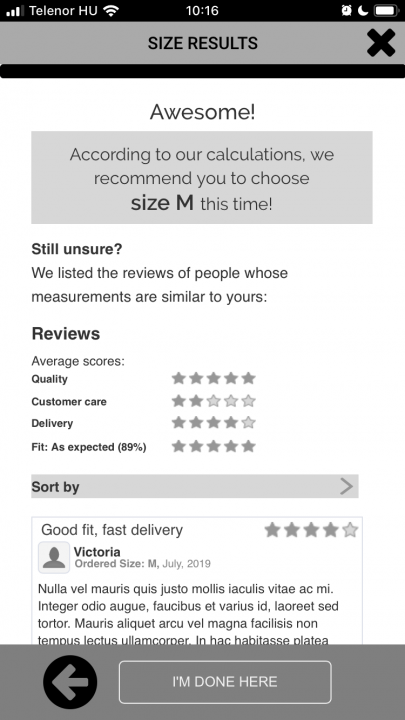
Making our ideas tangible with quick prototypes and test them as soon as we can save a lot of fourth dimension and resource. What nosotros call a prototype here is a modest-looking clickable digital product that resembles the features we aim to develop but in a simplified mode.
Paper-based prototypes exist too, but we prefer the freedom and opportunities digital solutions can provide. The goal here is to discover the usability issues before starting the detailed designs to avoid wasting fourth dimension and doing unnecessary reworks.
How we build prototypes:
- We mainly use Axure for interactive low-fi prototypes. With Axure, we tin can add together dynamic elements, Javascript, or create databases. These are uniquely circuitous features in the earth of prototyping tools.
- At that place are e'er iii essential questions the user should be able to answer on every screen nosotros design: Where am I? What tin I exercise hither? How can I move frontward?
- Forget lorem ipsum and be scarce with dummy text. A sensible, contextual, guiding copy is just as important every bit visual hierarchy and affordances.
- We follow UI patterns and keep all-time practices in mind.
- We go on it simple. We're testing the usability of layouts, central user flows, and navigation at this bespeak. However, nosotros don't test refined visuals yet unless it's non an MVP and we are testing already existing features in a live product.
- We pattern for mobile first if the project allows.
We create the commencement prototypes as presently equally we tin and evaluate them for usability tests . Refining the prototype iteratively after every usability exam until we're confident that nosotros ruled out every major usability chance is a must. Of course, later, nosotros continue usability testing before and during designing every new characteristic.
High-fidelity prototyping
Now that we take the base of a usable production, it's time to add together the visual attributes, colors, icons, shadows, and images and refine the look and experience. The product's blueprint language should be aligned with the brand'south vision. When testing the high-fidelity prototypes, visual elements are as well important, and they pb to creating a stable, harmonized design system that we can rely on.
Quick tips for hullo-fi prototypes:
- Create and maintain a pattern system based on brand guidelines and vision. Design systems facilitate effective collaborative piece of work. They besides convalesce conclusion fatigue, and assist designers in keeping consistency throughout the product. Even if information technology's an MVP, the goal is to scale upward the product if everything goes right. So building a pattern arrangement is inevitable at some point when managing a successful product pattern process. It'south better to start edifice it sooner rather than later.
- We mainly utilise Figma, Sketch, or Adobe XD at UX studio. Notwithstanding, the choice often depends on the preferences of our client's team and the technical requirements.
- Some tools, like Figma, have a built-in collaborative feature. Abstruse besides can be a keen complementary software for version control and storing files in the cloud. We consign our design files to Zeplin for the developers.
- Ideating and prototyping should be an iterated process, such as continuous discovery with user research beyond MVPs.
Takeaways
Launching the minimum feasible product doesn't hateful the job is done, and the product blueprint procedure is over. Testing and designing should be an ongoing, iterative process. This is the key to improve the product and bring information technology to success.
Follow along with the metrics. Go customer feedback, use analytic tools and heatmaps, exercise A/B testing, and measure the success of our choices.
This collection of ideas and steps we went through are not set in stone. Information technology is simply an overview of bachelor tools and methods we consider necessary to start off a product pattern process. The whole process becomes super iterative when working in a dynamic, agile surround.
The main takeaways are to make the process user-centered, utilise design thinking, and execute it as a non-linear, iterated procedure. Do user research whenever possible to blueprint with the people, not just for them.
Searching for the right UX agency?
UX studio has successfully handled 250+ collaborations with clients worldwide. Is there annihilation we can do for you at this moment? Get in affect with the states , and let'due south talk over your current challenges. Our experts volition be happy to assist with the UX strategy, product and user research, and UX/UI blueprint.

Source: https://uxstudioteam.com/ux-blog/product-design-process-steps/
Posted by: edwardswiging.blogspot.com
0 Response to "how to draw like a product designer"
Post a Comment